
How Taiwanese Whisky Differs from Japanese and Scotch Whisky

Canadian whisky drinkers are seeing more Taiwanese bottles on the shelf. If you already know Scotch or Japanese whisky, it is natural to ask how this newer category compares. The short answer is not that Taiwanese whisky is a younger stand-in for either tradition. It is that a humid subtropical warehouse climate treats oak differently, and that the casks themselves are often different.
This article answers that comparison from Bunnyville, a distillery on Taiwan’s western side, near the Taiwan Strait — not from Yilan, where Taiwan’s best-known whisky name is based. The craft is shared. The climate, the casks, and the resulting flavour are not.
Three traditions, not a ranking
Taiwanese, Japanese, and Scotch whisky all draw on a similar distillation craft. Scotland wrote much of the textbook. Japan studied that textbook closely and then built a style of its own. Taiwan’s industry is younger, and it too began by learning from Scottish practice. What matters now is not who copied whom, but how each place has gone its own way.
Japanese whisky is often prized for balance and precision; Scotch, for range, from unpeated Speyside malts to richly peated island styles; Taiwanese whisky, for the stronger oak character and richer, deeper flavour that come from intensified extraction in a humid subtropical warehouse. The useful question is what you taste, not which country ranks higher.
What Taiwan’s subtropical climate does to oak and flavour
Intensified oak extraction — not a race against the calendar
Heat and humidity do not turn a young whisky into an older one by a tidy formula. What they do is intensify the conversation between spirit and wood. In a warm, humid warehouse, the spirit moves in and out of the oak with more intensity than it would in a cool Scottish dunnage warehouse. More of the barrel’s character comes into the whisky: vanilla and baking-spice notes, toasted wood, tannin, and structure. The result is a stronger oak character and a richer, deeper flavour — more wood, more depth, not simply fewer years in cask.
Flavour may also become more concentrated, but the useful frame is still intensity, not a calendar. A younger Taiwanese whisky is not the equivalent of an older Scotch or Japanese whisky. Distilleries still have to judge the right moment to bottle, so the oak stays in balance. People sometimes ask why Taiwanese whisky “ages faster.” It is a common way of putting the question. The better answer is not a conversion chart: Taiwan’s climate intensifies oak extraction and flavour depth.

Place, water, and the Taiwan Strait
Bunnyville stands in western Taiwan, close to the Taiwan Strait. It received a legal liquor-making licence on 15 July 2004 at Rabbit Hole Village (Tukeng) in Guishan. A second distillery began operating in 2023, with a capacity of 1 million bottles a year, and the still house includes six pot stills and two column stills.
Taiwan’s water is abundant, and Bunnyville has long described it as the soul of the whisky, contributing to a sweeter, more distinctive body.

How the three styles typically taste
These are generalisations, not promises about every distillery or every cask.
Scotch — range, place, and peat
Scotch whisky is not one flavour. Unpeated malts can be floral, honeyed, fruity, or robustly sherried. Peat is an important Scottish tradition, especially on Islay and some other islands, but it is not the taste of all Scotch. Cool warehouses are part of that tradition, and they tend to produce a measured conversation with oak rather than a forceful one.
Japanese whisky — balance and precision
Japanese whisky is often described in the language of harmony: orchard fruits, blossom, cereal sweetness, and a clean, layered finish in which no one note shouts. Distilleries that studied Scottish methods then pursued refinement — careful blending, precise cuts, and a taste for balance over volume. In 2021, the Japan Spirits & Liqueurs Makers Association published voluntary labelling standards that made the “Japanese whisky” designation clearer; they are a trade consensus, not a statute. The useful contrast is stylistic: Japanese whisky often asks you to notice poise. Taiwanese whisky often asks you to notice oak and cask.
Taiwanese whisky — stronger oak and cask-driven depth
Typical Taiwanese single malt has a generous body, a clear oak signature, and fruit that leans toward ripe or tropical rather than crisp orchard notes. Vanilla, spice, and cask flavour sit closer to the centre of the glass, a depth that comes back to intensified oak extraction. When the cask itself has a story — sherry, bourbon, or, in Bunnyville’s case, tea, fruit liqueur, or Taiwanese wine — those flavours have a strong stage on which to appear.
Casks Taiwan can call its own
Bourbon, sherry, and port casks are still widely used in Taiwan. They are not the whole picture.
Bunnyville seasons oak casks with its own tea liqueurs, fruit liqueurs, and Taiwanese wines, then transfers already matured single malt into those casks for a second maturation. The logic will be familiar if you know how a sherry cask is prepared: the cask is raised on one liquid, then it lends that character to the whisky.
The tea programme is the clearest example, and it is still rarely explained in English comparisons of the category. Taiwanese tea is made into a tea liqueur and matured in oak, so that tannin, honeyed sweetness, and a hint of smoke settle into the wood; the whisky then goes into those casks. Oolong and jasmine tea finishes are the flagships. The oolong tea cask has received Gold at the IWSC (95 points) and Gold at the San Francisco World Spirits Competition; the jasmine tea cask received Double Gold at the SFWSC in 2023.

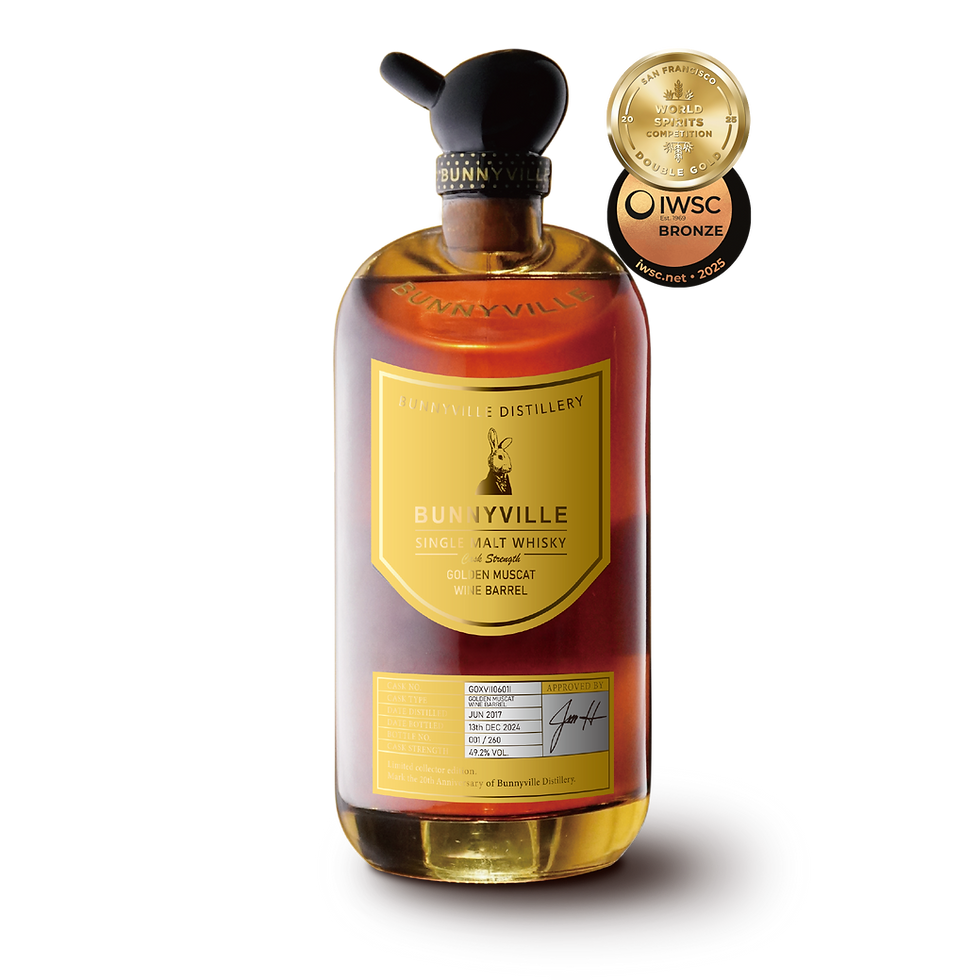
The same approach extends to local fruit and wine, including lychee liqueur, plum, and Taiwanese wines such as Golden Muscat and Black Queen. The lychee and Golden Muscat cask-strength malts are useful bottles if you want to taste that idea; both have received SFWSC Double Gold, the Golden Muscat in 2025. These are Taiwanese ingredients, used in the same seasoning logic as a European fortified-wine cask, then set in a climate that already intensifies oak.
A wider Taiwan than one famous distillery
Kavalan is the best-known Taiwanese whisky internationally, and it deserves to be on any first reading list of the category. It is not the only distillery worth knowing. Nantou’s Omar and Yushan bottlings, often noted for fruit-cask work, are part of that wider map.
Bunnyville is another independent example, on a different coast. Beyond the tea and fruit casks already described, the range includes No.19 Peated, a peated single malt and the brand’s first Taiwan-made peated whisky, and No.17, a wheat single grain. No.19 Peated is made with Scottish peated malt and matured in new American oak, port casks, and American bourbon barrels. The distillery describes peat smoke, honey, pear, and roasted oak, with a dark-chocolate finish, and presents it as an approachable introduction to peat that can also sit with seafood. It received Silver at the SFWSC and Bronze at the IWSC in 2025.


Some English guides still treat peat as essentially absent from Taiwan, and the category as a single famous name. A region that bottles peated malt, single grain, tea-seasoned casks, and local wine finishes is wider than that story suggests. Bunnyville has received more than 87 medals at international spirits competitions; the medals are evidence, not the argument. The argument is the range.
How to choose a bottle
If you already drink Scotch or Japanese whisky and want a clear first impression of Taiwan, start with a Taiwanese single malt and look for the oak and the body. You are tasting intensified extraction, not a substitute for a longer-aged European or Japanese bottle.
If you are curious about something the other two traditions rarely offer, look at Bunnyville’s tea casks or at finishes in local wine and fruit casks. If you have been told that Taiwan has no peat, try No.19 Peated. If grain whisky is your usual pour, No.17 is the wheat single grain in the same range.
These bottles are not assumed to be on every provincial liquor-board shelf in Canada. Browse the whisky collection, or write to jimh@bunnyville.ca about samples and Canadian distribution. Some enquiries may require a local liquor licence; see About us and the company timeline.
Questions people ask
How is Taiwanese whisky different from Japanese whisky and Scotch?
Taiwanese, Japanese, and Scotch whisky share a common craft, but they do not taste the same. Scotch is known for its range — from unpeated, place-driven malts to richly peated island styles — shaped in a generally cool climate. Japanese whisky is often prized for balance, precision, and a layered, harmonious profile. Taiwanese whisky is marked by a humid subtropical warehouse climate that intensifies oak extraction, giving a stronger oak character and a richer, deeper flavour, often with generous fruit and cask notes. The difference is style, not a scoreboard.
What does Taiwan’s subtropical climate do to whisky?
In Taiwan’s humid subtropical climate, the exchange between spirit and oak is more intense than in a cool Scottish warehouse. That intensified oak extraction gives the whisky a stronger oak character and a richer, deeper flavour — more wood, more depth, not simply a shorter time in cask. It is not a younger version of Scotch or Japanese whisky, and a bottle’s age statement is a poor substitute for tasting the oak, the cask, and the spirit together. Distilleries still have to judge the right moment to bottle, so the wood stays in balance.
Is Kavalan the only Taiwanese whisky worth knowing?
Kavalan is the best-known Taiwanese whisky internationally, but it is not the whole region. Other Taiwan distilleries bottle single malt in the same subtropical climate, and some — including Bunnyville, on Taiwan’s western coast near the Taiwan Strait — also finish whisky in tea-seasoned casks and in casks that previously held local fruit liqueurs or Taiwanese wines. There is even Taiwan-distilled peated malt and single grain whisky. If you are curious about the category, look past a single famous name and taste how different casks show that intensified oak and fruit.
Taiwanese whisky shares a craft with Japanese whisky and Scotch, but it does not taste like a copy of either. A humid subtropical climate intensifies oak extraction, giving a stronger oak character and a richer, deeper flavour — not a shorter wait. The category is also wider than one famous distillery, and tea, fruit, and local wine casks are part of what Taiwan can now put in the glass.
When you are ready to taste that difference, start with the whisky collection, or get in touch at jimh@bunnyville.ca.


Comments